


What is the Steel Cord Conveyor Belt?
A steel cord conveyor belt is composed of steel cords (such as ST800, ST1000, ST1250, ST1400, ST1600, ST1800, ST2000, ST2250, etc.) with a rubber cover. The manufacturing process includes steel cord weaving, rubber compounding, extrusion, and vulcanization.
Compared with EP conveyor belts, steel cord conveyor belts offer significantly higher tensile strength, as well as superior abrasion and corrosion resistance. More importantly, the exceptional tensile strength of steel cords eliminates the issues of deformation and excessive stretching commonly associated with EP conveyor belts. As a result, steel cord conveyor belts are better suited for long-distance, heavy-load, and high-speed conveying applications. They are widely used in industries such as mining, steel mills, ports, construction materials, and metallurgy, particularly in harsh environments and high-intensity operating conditions.
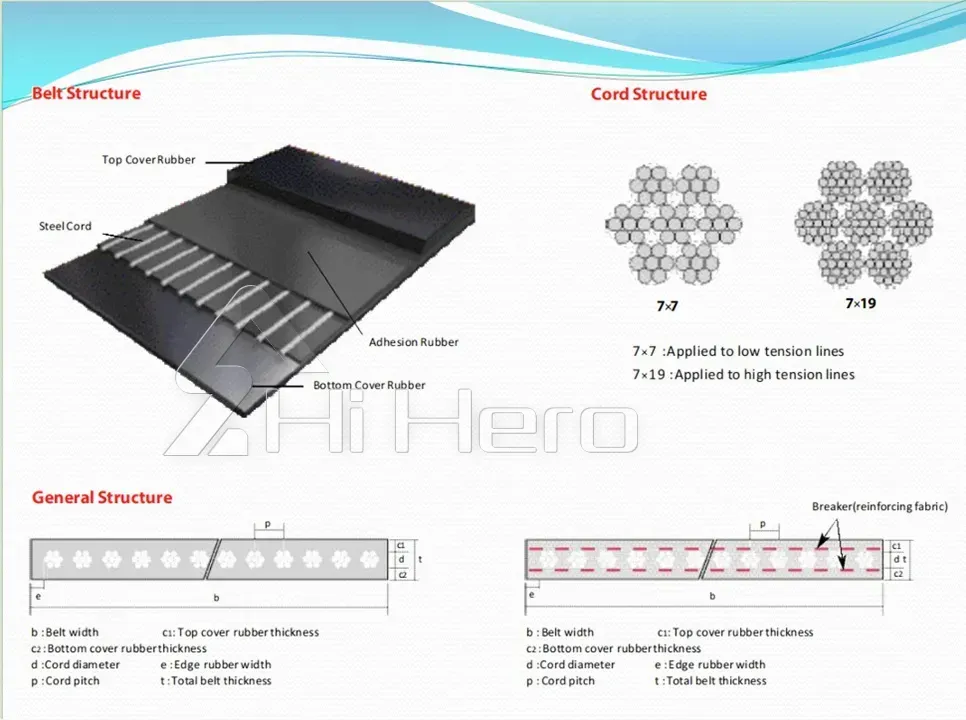
Characteristics:
High tensile strength: The conveyor belts are well suited for large-span and long-distance material transportation.
Low elongation during operation: Only a very short take-up stroke is required during use.
Small drive pulley diameter: The belt body uses longitudinally arranged steel cords as its reinforcement, providing excellent resistance to flex fatigue. This allows the use of smaller drive pulleys and helps reduce overall equipment size.
Strong adhesion between rubber and steel cords: The steel cords are zinc-coated, and the rubber compound has strong bonding properties. This results in tight adhesion, good impact resistance, minimal rubber separation, and long service life.
Uniform steel cord tension: Advanced manufacturing techniques ensure even arrangement and consistent tension of the steel cords, allowing smooth operation and reducing the risk of belt misalignment.
Excellent troughing capability: With no transverse reinforcement in the belt structure, the belt easily forms a deep trough, enabling higher material capacity and preventing spillage.
X-ray inspection capability: X-ray detection can be used to inspect internal damage to the steel cord structure during operation, helping prevent potential accidents.

Steel Cord Conveyor Belt Specifications
| Item | ST630 | ST800 | ST1000 | ST1250 | ST1600 | ST2000 |
|---|---|---|---|---|---|---|
| Longitudinal tensile strength (N/mm) | 630 | 800 | 1000 | 1250 | 1600 | 2000 |
| Steel cord diameter (mm) | 3.0 | 3.5 | 4.0 | 4.5 | 5.0 | 6.0 |
| Cord spacing (mm) | 10 1.5 | 10 1.5 | 12 1.5 | 12 1.5 | 12 1.5 | 12 1.5 |
| Top cover thickness (mm) | 5 | 7 | 7 | 7 | 8 | 8 |
| Bottom cover thickness (mm) | 4 | 4 | 5 | 5 | 6 | 6 |
| Item | ST2500 | ST3150 | ST3500 | ST4000 | ST4500 | ST5000 |
|---|---|---|---|---|---|---|
| Longitudinal tensile strength (N/mm) | 2500 | 3150 | 3500 | 4000 | 4500 | 5000 |
| Steel cord diameter (mm) | 7.2 | 8.1 | 8.6 | 8.9 | 9.7 | 10.9 |
| Cord spacing (mm) | 15 1.5 | 15 1.5 | 15 1.5 | 15 1.5 | 16 1.5 | 17 1.5 |
| Top cover thickness (mm) | 8 | 8 | 8.5 | 8.5 | 9 | 9 |
| Bottom cover thickness (mm) | 6 | 6 | 6.5 | 6.5 | 7 | 7 |
Rubber Cover Grade
| Grade | Code | Tensile strength (MPa) | Strength at break (MPa) | Abrasion loss (mm³) | Tensile strength change after aging at 70C 7 days |
|---|---|---|---|---|---|
| Anti-split | H | >25.0 | >450 | 120 | -25% to +25% |
| General purpose | D | >18.0 | >400 | 90 | -25% to +25% |
| Anti-abrasion | L | >20.0 | >400 | 150 | -25% to +25% |
If you are interested in sending in a Guest Blogger Submission,welcome to write for us!
Comments
0